
Overview of content:
Tools and Resources
All manuals can be downloaded
Upcoming events
Dear colleagues,
Written by, Yuriy Usovich and Wika Solonicyna, AHALAR Center
With 1.2 million officially registered combatants and projections of 5–6 million veterans after the war, the country is set to have the largest veteran population in Europe. A critical gap exists between need and access: 20–40% of veterans require psychological support (240,000–480,000 people), yet only 4–5% receive systematic care.
Clinical indicators are alarming. 67.4% of service members meet criteria for PTSD, 33% show signs of depression, and 50–70% report depressive symptoms during screening. Sleep disturbances, emotional numbing, chronic hypervigilance, and somatic complaints have become the norm for hundreds of thousands of Ukrainians.
What makes this situation unique is that veterans are not returning to peace, but to a country still at war. Air raid sirens, family members on the front lines, and a persistent sense of threat intensify trauma in ways not accounted for in standard postwar recovery models.

The Body as a Path to Healing
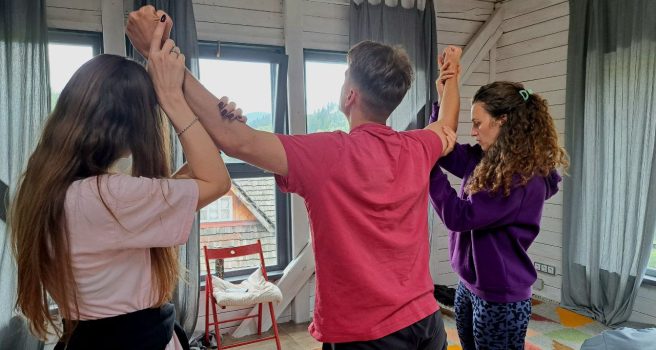
The AHALAR Center has developed an innovative response to this crisis. Our “Body. Resource. Balance” retreats employ a somatic approach, grounded in the understanding that trauma lives in the body before it can be processed cognitively. The program serves veterans with PTSD, widows of fallen soldiers, partners of service members, family members of veterans, and couples.
Participants consistently present with a shared pattern: chronic hyperactivation alternating with emotional “freeze,” constant vigilance even in safe environments, profound exhaustion masked by an inability to rest, and somatic symptoms ranging from pain to panic attacks.
The intervention integrates seven evidence-informed modalities delivered through intensive multi-day retreats:
- Somatic practices (grounding, breathwork, movement) to address chronic nervous system activation
- Mindfulness to recognize bodily signals before crisis escalation
- Psychoeducation on stress and trauma, reducing self-blame and increasing perceived control
- Art therapy, offering non-verbal channels for trauma processing
- Reflective group circles, creating safe mutual support
- Nature-based practices, leveraging the regulatory effects of natural environments
- Individual support, addressing personal trauma not suitable for group work
This approach reflects contemporary trauma science: the most effective interventions combine bottom-up somatic regulation with top-down cognitive understanding, embedded in safety and social connection.
Measurable Outcomes through retreats at AHALAR Center
Across five retreat cohorts, participants demonstrated consistent improvements:
- Significant reductions in anxiety and nervous tension — often the first sustained calm in months or years
- Improved sleep quality, a primary indicator of nervous system recovery
- Return of emotional responsiveness — the ability to feel, connect, and be present
- Concrete self-regulation skills — practical tools for independent stress management
- Restoration of inner stability — not merely relief, but sustained access to internal resources
- Improved relationships — for couples, the capacity to support one another without destructive dynamics
These outcomes align with international evidence: interventions that strengthen self-regulation and social support reduce trauma symptoms even amid ongoing conflict.
A Systemic Challenge
The work of AHALAR Center exists within a much broader context. The Ministry of Health projects that 15 million Ukrainians will require mental health support, including 3–4 million needing medication and 3.9 million requiring intensive psychological care.
Current infrastructure is critically insufficient: 1 psychologist per 100,000 people, compared to 34 per 100,000 in the United States. While the government has established 125 mental health centers and is training thousands of healthcare workers, the scale of need remains overwhelming. Persistent Soviet-era stigma surrounding psychiatry further limits help-seeking.
Time-limited, intensive, group-based intervention models show strong potential for scalable impact: stabilizing acute symptoms, teaching self-regulation, building peer support networks, and preparing participants for longer-term therapy.
Why This Matters Globally
The international community has a stake in this crisis. Failed veteran reintegration correlates with social instability, violence, substance use, and suicide. Effective support, by contrast, transforms veterans into community assets, bringing leadership skills and commitment to social cohesion.
The choice between these trajectories depends on resources, policy support, and the scaling of evidence-based interventions.
As one participant put it: “For the first time in months, I felt that I could breathe. I learned that calm is possible inside my own body.”
Scaling this experience to hundreds of thousands of veterans is not only therapeutic work — it is an investment in Ukraine’s postwar future.
Find tools and resources below
This video was filmed during the “Body. Resource. Balance” recovery retreat hosted by the AHALAR Center for veterans, military personnel, and their families.
It presents the story of a woman veteran, military spouse, and mother who describes her path toward recovery through body-based practices, movement, and a safe, supportive environment.
The retreat offers a space to acknowledge exhaustion, set down the armor, and reconnect with inner balance. Through movement, touch, ritual, and shared presence, participants explore healing and post-traumatic growth, a gradual return to clarity, strength, and the capacity to move forward.
On Wednesday March the 11th at 11 o`clock Ukraine time MHHRI, togheter with collaborative partners, are inviting you to the 2nd webinar about Ukrainian veterans and the way forward. More information will follow, check out our social media.
Supporting Veterans
The return of veterans and combatants to civilian life after their service often poses significant challenges.
Veteran Profiles And Reintegration Challenges In Ukrain...
IOM
This report draws on a probabilistic sample that combines responses from a short ‘screener’ survey, as well as responses to an in-depth individual survey, which was supplemented by a targeted, ‘booster’ sample of veteran respo...
Scaling-up mental health and psychosocial services in w...
WHO
In her address to the 75th World Health Assembly, the First Lady of Ukraine, Olena Zelenska, highlighted the mental stress experienced by Ukrainians because of the war in Ukraine. She spoke of residents of Kharkiv – who had been living underground in...
Government approves Veterans Policy Strategy up to 2030
GOV.UA
The Cabinet of Ministers of Ukraine approved the Veterans Policy Strategy up of 2030 and the operational plan of measures for its implementation in 2024-2027. This is a fundamental document that should ensure comprehensive changes and development of ...
Key to empowering veterans and returning combatants lie...
2022Office of Veterans Affairs
The purpose of this desk aid is to help you better understand veterans and their families who might interact with your policies or services, be a customer or require support and advice. Understanding more about this community will allow you to design...
How Common is PTSD in Veterans?
2022US department of veterans affairs
When you serve in the military, you may be exposed to different traumatic events than civilians. The war you served in may also affect your risk because of the types of trauma that were common. War zone deployment, training accidents and military sex...
Sleep Problems in Veterans with PTSD
2022Department of Veterans Affairs
Sleep problems—in particular chronic insomnia and nightmares—are frequently some of the most troubling aspects of PTSD. While these sleep problems are considered symptoms of PTSD, the evidence suggests that they tend to become independent problems ov...
Suicide prevention and peer support in the Armed Forces
2022SSAFA
Being in the Armed Forces means that you are exposed to a higher degree of risk and pressure than you might expect in other jobs. This booklet is intended to help you look out for your teammates by giving you guidance on how to discuss things with th...
Mechanisms of Risk and Resilience in Military Families:...
2011National Library of Medicine
It is increasingly clear that wartime deployment is a family matter. Almost half of today’s active duty forces are parents, and continuing hostilities in Iraq and Afghanistan ensure that growing numbers of military families will experience repeated c...
Resilience in a Time of War
The American Psychological Association
No one knows how long a war will last or how it will affect our lives. We may feel uncertain about the future and anxious about events that are out of our control. You may react differently to a war today because of the impact of the September 11, 20...
Veteran and Military Suicide Prevention Resources
2022Action Alliance
The webpage that provided resources related to veteran and military suicide prevention. It likely contains information, support services, and resources aimed at preventing suicide among veterans and active-duty military personnel. These resources may...
Veteran suicide prevention
2022U.S. Department of Veterans Affairs
U.S. Department of Veterans Affairs (VA). A resource page specifically focused on suicide prevention within the context of mental health care for veterans. The VA offers a wide range of services and support for veterans, including mental health care,...
Керівництво із самодопомоги. Self-Help Guide Topics
2023Combat Stress, the UK’s leading charity for veterans’ mental health
Керівництво із самодопомоги було розроблено фахівцями з питань психічного здоров’я, які працюють у Combat Stress у співпраці з ветеранами. Серія була спеціально розроблена, щоб надати поради та підтримку колишнім військовослужбовцям і жінкам, які маю...
Ministry of Veterans Affairs of Ukraine
The Ministry of Veterans Affairs of Ukraine is the central executive body responsible for the formation and implementation of state policy in the field of social protection of war veterans, persons who have special merits to the Motherland, and their...

All our gender-based violence manuals can be downloaded for free from the MHHRI website
Three gender-based violence manuals have been developed to support helpers working with women, boys and men, and children who have experienced sexual violence.
These manuals are available in multiple languages, enabling survivors and helpers to access the content in their preferred language while maintaining consistent headlines and numbering. This multilingual approach facilitates teaching when participants and trainers speak different languages. Each manual includes a toolbox of grounding exercises that survivors can use on their own, to manage emotions or in collaboration with a helper. Additionally, helpers can use these exercises for their own self-care.
Upcoming events
FASSTT Conference
The 4th Australian and New Zealand Refugee Trauma Recovery in Resettlement Conference, Sydney 4 – 6 May 2026.
Sixteenth International Sakharov Conference. Authoritarianism on the Rise
Engage with global experts in Vilnius on democracy, human rights, and resistance to authoritarianism. 22-22 May, Vilnius.
Stronger Together: Prioritise Mental Health in a Changing Europe
It is held simultaneously across Europe and online. The event is designed for local organisations, public institutions, professionals, and citizens to host their own activities (such as workshops, seminars, and social media campaigns) within their respective countries and cities. 4 – 8 May 2026
Hot Brain 4: Climate Change and Neurological Disorders – Mechanisms
This hybrid conference examines the biological impact of climate change on brain health and the progression of neurological diseases. It focuses on identifying physiological mechanisms to drive global research, healthcare adaptation, and urgent action against environmental threats to the nervous system. 12 May 2026. London, UK
Bold Ideas for Brighter Futures 2026: 2nd Global Conference on Child and Adolescent Mental Health
This global conference brings together stakeholders to share cutting-edge research and practical innovations aimed at improving the mental health of children and adolescents. 18-20 May 2026. Cape Town, South Africa
Healing Childhoods – Mental Health Interventions for Children Affected by War, Emergencies and Displacement
This conference addresses the profound psychosocial consequences for millions of children growing up in the midst of war and armed conflict. 8 June 2026. Bergen, Norway
Digital Mental Health International Conference 2026 (DMH 2026)
This premier platform addresses global mental health needs by exploring the rapid development of digital technologies. 16-18 June 2026. Hong Kong, China & Online
21st European Symposium on Suicide and Suicidal Behaviour (ESSSB21)
This symposium gathers researchers, clinicians, and advocates to share new ideas and research in suicide prevention under the theme Rethinking Suicide Research and Prevention. 26-29 August 2026. Vilnius, Lithuania
World Congress of Psychiatry WCP
Together with our member society, the Swedish Psychiatric Association, the World Psychiatric Association (WPA) is thrilled to invite you to the 26th WPA World Congress of Psychiatry (WCP 26) in the vibrant city of Stockholm, Sweden, from 23-26 September 2026.
ISTSS 42nd Annual Meeting
Annual Meeting is a global forum for professionals and researchers dedicated to understanding and addressing the impact of trauma. We bring together diverse perspectives to advance scientific knowledge, develop effective treatments, and inform public policy. September 23-26, 2026, in San Antonio, Texas, USA.
The SVRI Forum
Is the world’s leading conference on research, evidence, and solutions to prevent and respond to violence against women (VAW), violence against children (VAC), and other forms of gender-based violence (GBV).
Bangkok, Thailand from 5 – 9 October 2026
We appreciate feedback and comments
Welcome to our new subscribers, we hope you will find our content useful. The Mental Health and Human Rights Info Newsletter is a newsletter with the aim to provide insight on a certain subject across the scope of our work; human rights violations in war and conflict areas and mental health. Our intention is to deliver a newsletter as a short “lecture” where you can find relevant information regarding a specific subject from a mental health perspective. You will receive our newsletter 5 times a year.
We would appreciate your thoughts and suggestions on other issues you would like to see in this newsletter or if you are planning an event on related issues, please let us know so we can include your event in our newsletter.
If you know anyone who would be interested in receiving this e-newsletter, please forward it, and encourage them to sign up.
Facebook and Instagram
On our MHHRI Facebook page, and on Instagram we are continuously posting new and relevant articles that we add to our website, as well as events and videos. We also just launched our new LinkedIn page!
Sincerely yours,
Take care – and we are wishing you all the best.
Sincerely yours,
Mental Health and Human Rights Info teampost@hhri.orgwww.hhri.org
Copyright © 2025 MHHRI.ORG All rights reserved.
MHHRI are not responsible for the content of external websites. Links are made because we think the content might be of use. The comments and evaluation on this page are made by our staff to make the links more accessible to you, and is entirely our subjective impression of the link in relation to our context.
Our mailing address is:
Post@hhri.org